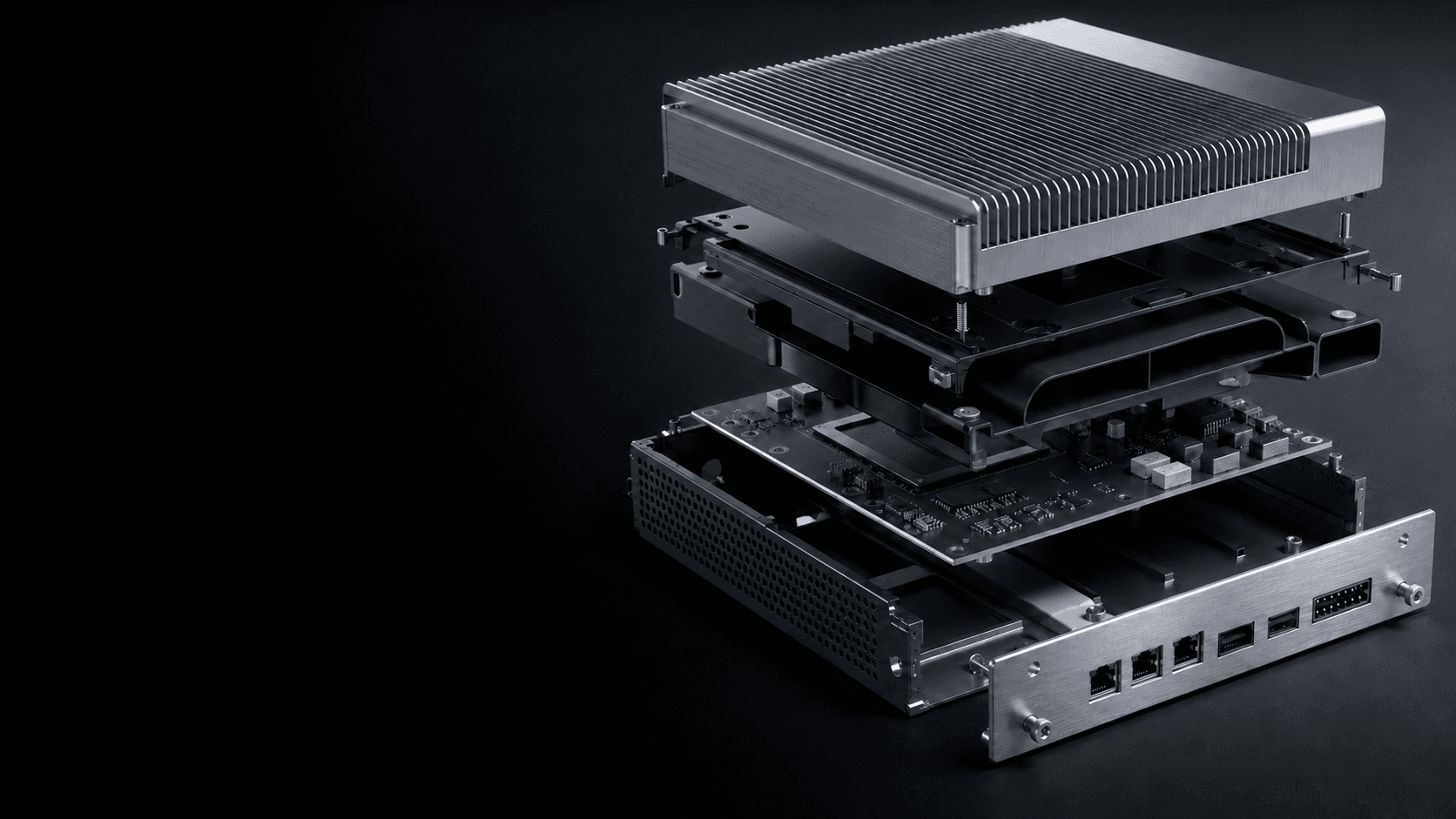
AI hardware manufacturing
Compute needs
a physical system.
Mechanical manufacturing for compute, sensing, thermal architecture, and deployment hardware—reviewed around interfaces rather than unverified performance claims.
Conceptual CGI / No performance specification implied
Industry context
Software performance still depends on physical decisions.
Compute and sensing products bring electronics, thermal paths, structure, connectors, airflow, service access, and industrial design into the same constrained volume.
01
Compute architecture
Board layout, accelerators, power components, storage, and I/O establish the interfaces the mechanical system must support.
02
Deployment environment
Desktop, edge, mobile, rack, laboratory, or field use changes expectations for packaging, handling, finish, ingress strategy, and serviceability.
03
Development stage
Evaluation hardware, functional prototypes, design validation units, and low-volume builds require different balances of speed, fidelity, and repeatability.
Engineering challenges
Control the interfaces inside a dense physical stack.
Manufacturing choices should preserve the mechanical assumptions behind thermal management, electronics integration, assembly, and field access.
Thermal path definition
Contact surfaces, interface materials, airflow volumes, heat-spreading parts, and assembly pressure need clear ownership and validation intent.
Dense packaging
Boards, connectors, cooling hardware, antennas, cables, fasteners, and enclosure walls compete for limited space and assembly access.
Connector alignment
Panel openings, board location, datum strategy, retention, and tolerance stack-up must support mating without overstressing the electronics.
Service and revision
Access panels, replaceable modules, cable paths, fastener choices, and configuration control affect both development speed and deployment support.
Typical component types
Mechanical hardware around compute and sensing.
These component categories illustrate common engineering contexts. Final process, material, and achievable requirements are confirmed per project.
Compute and edge enclosures
Machined, fabricated, or molded housings developed around board layout, I/O, cooling architecture, mounting, and intended access.
Thermal-interface hardware
Heat spreaders, interface plates, heat-sink-adjacent structures, ducts, and retention parts manufactured to customer-defined geometry and requirements.
Sensor housings and mounts
Structures for cameras, depth sensors, microphones, radar, or other sensing hardware where field of view, alignment, and protection matter.
Connector panels and brackets
I/O panels, board supports, cable retainers, mounting brackets, and internal frames that organize the electromechanical stack.
Evaluation and deployment fixtures
Benchtop fixtures, module carriers, test housings, and integration hardware used to evaluate a physical architecture before release.
Manufacturing solutions
Choose around geometry, interfaces, and build stage.
No process choice on this page implies thermal, electrical, environmental, or compute performance. Requirements remain subject to engineering review and system validation.
Material considerations
Define the required behavior. Verify the complete assembly.
Material selection is connected to thermal architecture, structure, electrical integration, finish, process, and the customer's validation plan.
Thermal and structural intent
Identify where heat should move, which interfaces carry load, and which surfaces require controlled contact before selecting a material route.
Electrical integration
Grounding, isolation, antenna zones, coatings, and EMI-related intent must be defined by the product engineering team; manufacturing alone does not validate system behavior.
Environment and finish
Handling, cosmetic zones, corrosion context, cleaning, marking, and downstream assembly can change both base material and finish requirements.
Prototype to production
Learn from hardware without losing configuration control.
Physical builds can validate packaging and integration assumptions, then inform the controlled definition needed for repeatable low-volume manufacturing.
01 / PACKAGE
Architecture build
Evaluate board placement, cooling volumes, connector access, sensors, cable routing, mounting, and service envelopes.
02 / VALIDATE
Functional integration
Use assembled hardware to test customer-defined thermal, electrical, mechanical, acoustic, and usability requirements.
03 / CONTROL
Design release
Consolidate drawing revisions, interfaces, materials, finishes, hardware, labels, and inspection expectations.
04 / PRODUCE
Low-volume build
Manufacture approved configurations under the agreed scope while the customer retains responsibility for system qualification.
Quality considerations
Measure the interfaces that hold the stack together.
Inspection is based on customer drawings and agreed requirements. It does not constitute validation of compute, thermal, electrical, radio, or environmental performance.
Board and connector datums
Define how board supports, I/O openings, retention features, and external connectors relate across the mechanical stack.
Thermal contact geometry
Identify the surfaces, form requirements, assembly conditions, and inspection expectations relevant to the customer's thermal design.
Assembly and cosmetic zones
Separate hidden functional surfaces from visible product surfaces, and document hardware, gap, flush, and finish expectations where needed.
Revision evidence
Align the correct CAD, drawings, bill-of-material context, critical characteristics, and requested records before the build begins.
Related capabilities
The enclosure is not a single-process decision.
AI hardware programs can combine rigid interfaces, fabricated chassis, rapid development parts, and released polymer components within one product architecture.
AI hardware FAQ
Define the interfaces. Validate the system.
A complete RFQ helps engineering review manufacturability while keeping product-level performance claims with the responsible design and validation team.
01What should be included with an AI hardware RFQ?
Provide CAD, drawings, quantity, target material, finish, timing, board and connector context, assembly expectations, critical interfaces, and requested inspection records. Share thermal or electrical intent only to the level needed for manufacturing review.
02Do you guarantee thermal or compute performance?
No. We manufacture to agreed component requirements. Thermal architecture, compute performance, electrical behavior, firmware, and system validation remain the customer's responsibility unless a separate written scope explicitly states otherwise.
03Can prototype and production-intent parts use different processes?
Yes. An early build may prioritize learning, while a later build may prioritize released materials, surface definition, assembly repeatability, or tooling. Any process change should be reviewed for its effect on geometry and system behavior.
04Can several manufacturing processes be combined in one enclosure?
Yes. Machined interfaces, formed panels, additive ducts, and molded housings can coexist. Each part and the shared assembly relationships require project-specific review.
Start an AI hardware RFQ
Bring the physical architecture into focus.
Upload the geometry and describe the electronics interfaces, intended environment, material, quantity, timing, finish, and inspection expectations. Engineering will review before quotation.