Medical product development hardware
Build for intended use.
Document what matters.
Engineering-led manufacturing support for development, research, and test hardware where material context, surface condition, usability, and records must be defined clearly.
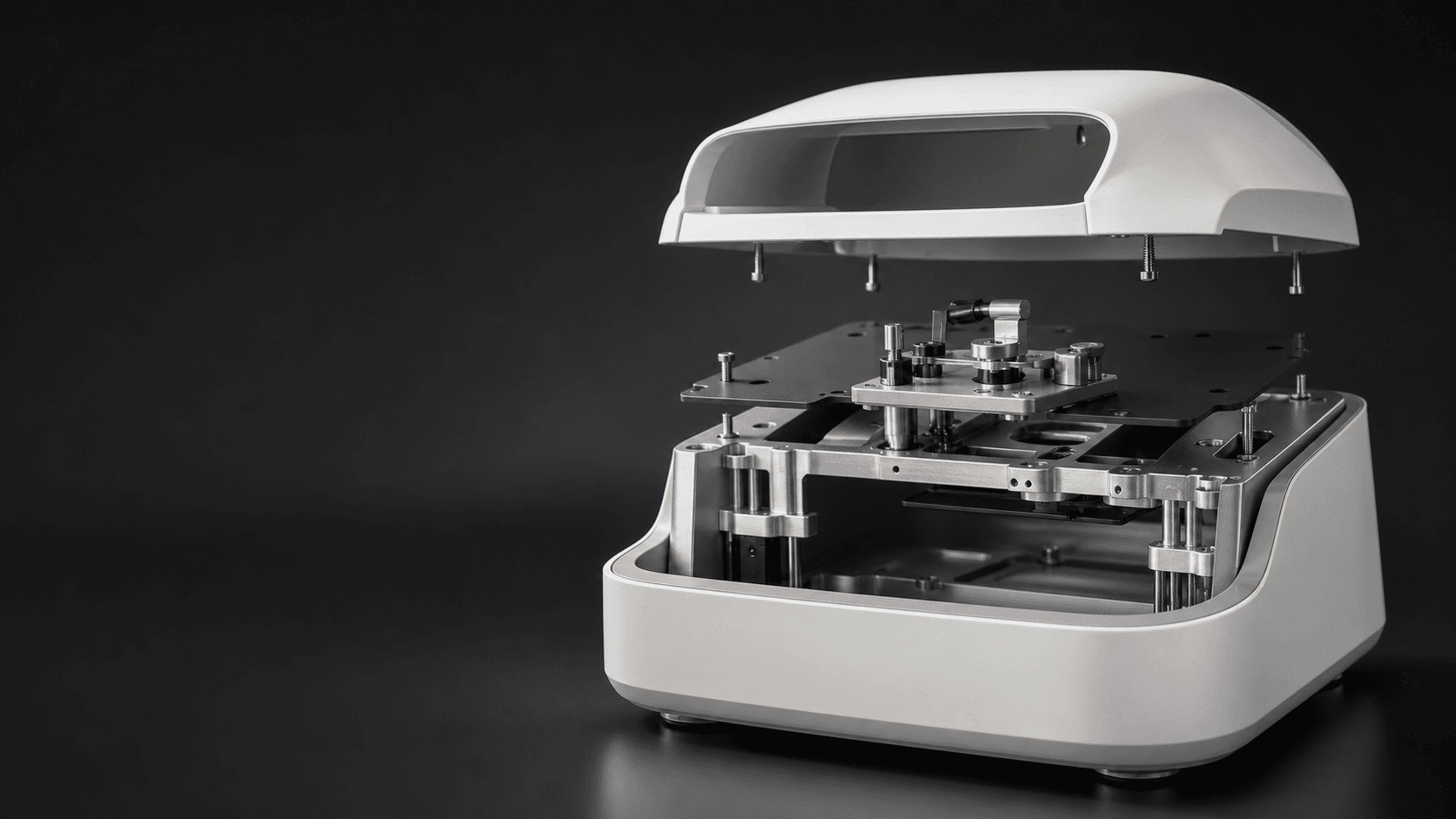
Conceptual CGI / Development context only / No clinical status implied
Industry context
The intended use defines the manufacturing conversation.
Medical product development can include research apparatus, instrument concepts, usability models, fixtures, and non-clinical engineering builds. Scope must be explicit before process decisions are made.
01
Development purpose
State whether hardware is for form studies, bench research, engineering verification, usability evaluation, fixtures, or another defined non-clinical purpose.
02
Use environment
Handling, cleaning context, chemicals, temperature, wear, visibility, and human contact can affect material, finish, assembly, and documentation needs.
03
Evidence expectations
Drawing control, revision history, material records, inspection scope, and part identification should be agreed rather than assumed.
Engineering challenges
Translate intended use into controlled requirements.
Manufacturing quality starts with a clear product-development brief. Regulatory strategy, device validation, and clinical suitability remain outside an implied website claim.
Material context
Mechanical, chemical, thermal, contact, cleaning, and documentation requirements need to be defined by the customer for the intended development use.
Human interaction
Grip, reach, visibility, edge condition, assembly gaps, weight, and controls can shape prototype fidelity and usability learning.
Controlled interfaces
Optics, fluid paths, electronics, sensors, actuators, fasteners, and replaceable elements can create critical mechanical relationships.
Documentation scope
The required drawing revision, material evidence, inspection records, traceability, and change control must be specified for each project.
Typical component types
Development hardware for defined engineering work.
The examples below do not imply certification, clinical use, sterility, biocompatibility, or suitability for any medical-device classification.
Instrument enclosures and housings
Mechanical structures for development instruments, laboratory equipment, displays, controls, and internal electronics.
Research and test fixtures
Benchtop fixtures, alignment tools, carriers, test interfaces, and apparatus components built to customer-defined engineering requirements.
Human-factor prototypes
Physical models used to evaluate form, reach, handling, interface position, assembly access, and other product-development questions.
Instrument mechanical components
Frames, mounts, brackets, covers, bezels, trays, and precision interfaces within a larger development assembly.
Protective and transport components
Development-stage guards, covers, carriers, and packaging-adjacent hardware where fit and handling context must be reviewed.
Manufacturing solutions
Select for the development question. Confirm every requirement.
Process selection depends on geometry, intended use, material requirements, quantity, finish, records, and development stage. No route implies regulatory approval or clinical suitability.
Material considerations
Material names are not a substitute for intended-use requirements.
The customer must define the relevant mechanical, chemical, contact, environmental, cleaning, and documentation context. Availability and process compatibility are reviewed afterward.
Intended use and contact
Clarify what the part contacts, for how long, in which environment, and for which development purpose. Do not infer suitability from a generic material family.
Cleaning and surface context
Describe chemicals, handling, surface condition, edge expectations, texture, appearance, and cleaning method where they affect the engineering requirement.
Records and substitution control
State grade, source restrictions, requested records, allowed substitutions, and part identification needs before quotation and production.
Prototype to production
Let each build answer a defined development question.
A staged approach can improve design definition while keeping intended use, revision status, evidence needs, and validation responsibility visible.
01 / EXPLORE
Form and interaction
Evaluate size, handling, access, visibility, control position, enclosure strategy, and other physical assumptions.
02 / EVALUATE
Engineering build
Test customer-defined mechanical, assembly, environmental, and functional requirements in the planned development context.
03 / DEFINE
Controlled release
Align CAD, drawings, material specifications, finishes, records, inspection criteria, and approved revisions.
04 / TRANSITION
Production transition
Move approved requirements into a repeatable build only after the customer defines the applicable quality and regulatory framework.
Quality considerations
Quality evidence must match the agreed scope.
This page does not claim FDA registration, ISO 13485 certification, medical-device certification, clinical suitability, or sterile manufacturing capability.
Drawing and revision control
Confirm the released CAD, drawing, revision, change history, and governing specifications before manufacturing begins.
Material records
Define the exact material evidence, source constraints, identification, and substitution rules required for the project.
Inspection definition
Identify critical characteristics, measurement expectations, sampling or full-inspection requirements, and requested output records.
Customer validation
Regulatory classification, risk management, verification, validation, clinical decisions, and final-use approval remain the customer's responsibility.
Related capabilities
One development program. Several possible production paths.
Process routes are evaluated around the defined development purpose. Material, finish, inspection, and documentation scope are never assumed from the industry label.
Medical development FAQ
Make the scope explicit before quotation.
A responsible RFQ identifies intended development use, requirements, records, and validation ownership without relying on broad industry assumptions.
01Does this page claim FDA or medical-device certification?
No. It does not claim FDA registration, ISO 13485 certification, medical-device certification, clinical suitability, sterile manufacturing, or regulatory approval. Applicable requirements must be identified and evaluated separately by the customer.
02What should be included in a medical development RFQ?
Provide CAD, drawings, quantity, timing, intended development use, material specification, finish, contact and cleaning context, critical characteristics, revision status, and exact inspection or documentation requirements.
03Can a generic material description establish medical suitability?
No. Suitability depends on the exact material, source, processing, environment, contact type, duration, cleaning method, risk assessment, and validation plan. The customer must define and approve those requirements.
04Who is responsible for device verification and validation?
The customer retains responsibility for regulatory strategy, risk management, device verification, validation, clinical decisions, and final-use approval unless a separate written agreement explicitly defines another scope.
Start a development RFQ
Define the intended use before the process.
Upload the geometry and specify the development purpose, material, quantity, timing, finish, revision, inspection, and documentation expectations for engineering review.